
hold
Chinese scientists develop electrode coating to address signal loss and tissue adhesion problems in long-term brain-computer interface implantation_我的网站

A |
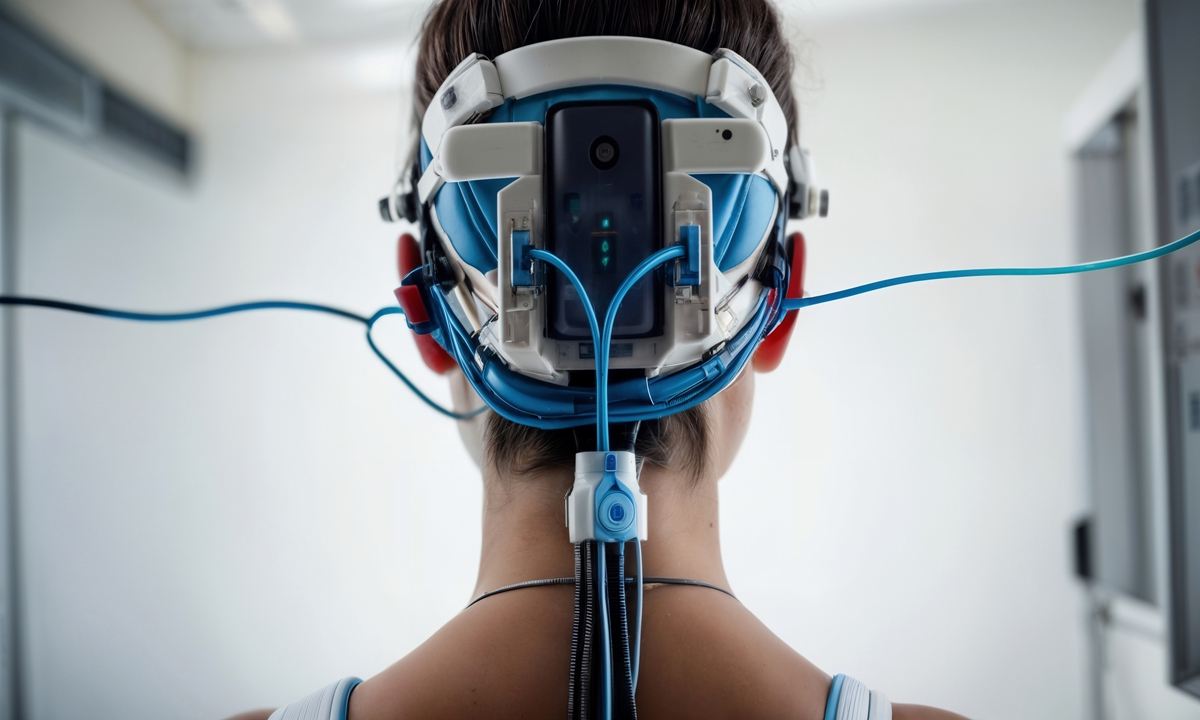
Chinese researchers have developed a multifunctional electrode coating that addresses key challenges in long-term brain-computer interface (BCI) implantation, including signal loss and tissue adhesion, bringing BCI one step closer to clinical application, the Global Times learned from the research team behind the findings on Sunday.
As an emerging field combining neuroscience and artificial intelligence (AI), BCI faces a major challenge of ensuring long-term compatibility between electrodes and brain tissue. Previous clinical trials showed that immune responses could cause implanted electrodes to retract after just three months, severely reducing signal quality and the number of available channels.
This problem stems from chronic inflammation triggered by implants, which creates insulating scar tissue around electrodes and separates them from neurons. Irreversible adhesion between electrodes and brain tissue after long-term implantation also makes device removal risky, potentially causing brain injury during follow-up surgeries.
Experiments showed that flexible neural electrodes coated with this material could operate stably in the brain for more than 300 days and could be safely removed without causing damage. This means the universal coating technology can make electrodes not only operate stably over the long term but can also be safely removed and replaced after aging, paving the way for long-term BCI applications.
Developed by the research team led by Zhang Wei at the Technical Institute of Physics and Chemistry, Chinese Academy of Sciences, associated with Beijing Tiantan Hospital, Shanghai Institute of Microsystem and Information Technology and NeuroXess, a high-tech life science company specializing in BCI technologies, the cationic alternating peptide electrode coating preserves electrode flexibility and conductivity, while offering antibacterial, anti-protein adsorption and immune-rejection-inhibiting functions.
A 300-day animal study showed the coating's effectiveness. Bare electrodes experienced a sharp loss of recording capability after 90 days of implantation and could barely detect neuronal signals after 300 days. In contrast, coated electrodes maintained stable recording channels and consistently captured neural signals above 155 microvolts.
In terms of neural modulation, after 300 days of implantation, conventional electrodes required a current of 100 microamps to induce weak limb responses, while coated electrodes triggered clear movements with only 2 microamps, improving modulation efficiency by 50 times.
Notably, the removal tests highlighted a key advantage of the coating that electrodes no longer form irreversible bonds with brain tissue. In the experiments, the coated electrodes were removed intact, with minimal damage to the surrounding brain tissue, Zhang told the Global Times on Sunday.
。 自AMD推出X3D系列处理器以来,凭借3D V-Cache技术带来的大容量缓存优势,X3D处理器一直是游戏玩家追求高性能体验的重要选择。在大量依赖缓存性能的游戏中,X3D处理器凭借更低的访问延迟和更高的缓存命中率,能够带来明显的帧率提升。而随着锐龙9系列X3D处理器采用双CCD设计,其定位也从单纯的游戏处理器,进一步扩展到了兼顾游戏与生产力的全能型平台。不过,双CCD设计也带来了一些新的挑战。

B | 除了旗舰的9950X3D2外,其余处理器的X3D缓存仅位于其中一个CCD,不同CCD在缓存容量和特性方面存在差异,系统需要根据不同负载进行合理调度。

C | 在实际使用中,默认调度策略并不能始终保证最佳性能表现,部分场景下可能出现游戏性能与生产力性能无法同时充分释放的问题。因此,如何进一步挖掘双CCD X3D处理器的潜力,也成为主板厂商优化X3D平台体验的重要方向。针对这一需求,技嘉为旗下X3D系列主板加入了X3D鸡血模式2.0技术,通过不同性能模式针对游戏和生产力场景进行优化,并配合OnFly X3D软件,让用户无需进入BIOS即可快速切换模式。此次我们将通过技嘉B850 AORUS ELITE X3D搭配锐龙9 9900X3D进行测试,看看开启不同X3D模式后,9900X3D能否在提升生产力性能的同时,在游戏表现上进一步接近锐龙9 9850X3D,并体验X3D主板对于处理器性能释放带来的实际提升。

D | 12345下一页。
Current article:http://7txw.senchuoshaozaodidia.shop/news/20260826_96141.html
Published on:13:01:18
 放话防到找不着北!小卡1V1百分大战对手锁定白晶:别想在我头上拿超10分
 央行今日开展2395亿元7天逆回购操作
 金球先生年龄:最年轻获奖者21岁大罗,最年长获奖者41岁马修斯
 通胀严重!美议员提议:废除美联储,生活会更好
 你敢信?全中国连夜排队买票,就为了看一部烂片
 挪威拟监管智能眼镜,考虑禁止公共场所人脸识别功能